
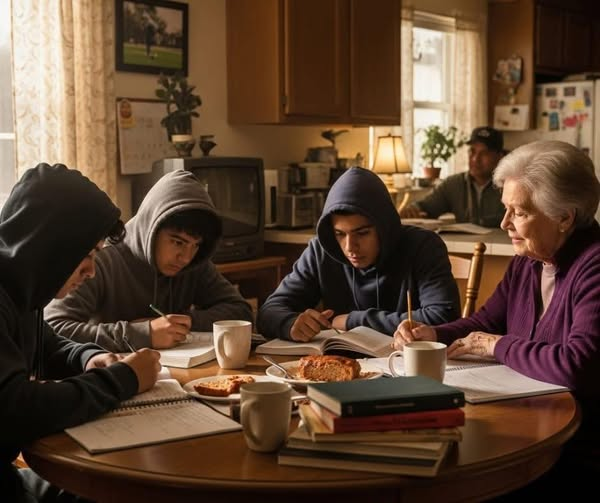
Grace Jenkins’ story about her kitchen table revolution got me thinking about why we need revolutions at all. Why isn’t this kind of authentic, caring education the norm instead of the exception? Grace shows us what works – one person with genuine care, using simple resources, meeting real needs. But her story also highlights something troubling: this natural approach to learning has become so rare that it feels revolutionary.
The Problem: What Went Wrong in Education
This isn’t only happening in schools. It’s happening in homeschool, too. And not only with mathematics. It’s the same for other subjects, and it’s happening at home. Mom is right there, with all the best textbooks, plenty of good food, and all the time you could want.
WHAT went wrong?
You don’t need numbers to prove you are smart or sensible or wise, but the world does look at it this way. Since Grace’s story was about helping with math, let’s stay on that topic. Feel free to insert any other subject that feels relevant to you. If you know numbers, and you have the holy paper writs, framed and displayed on altar walls – it is easy to fall into the trap of becoming the go-to guide for everything else. It’s not your fault; school trained you to think this way. So, what went wrong has more to do with thinking and logic than anything else.
The false equation: credentials = wisdom vs. Grace’s simple truth
Parents who see this early on in the system tend to take their children out of school within the first year or so, or they never allow their children to go to a school in the first place. They are not merely removing them from schools; they are sheltering and protecting young, impressionable minds from the stress and trauma of developing a flawed basis by which self-esteem grows. Yet, there are also parents who put in place the very damaging social parameters that you find in schools, in their own homes.
The Root Cause: Unhealthy Competition and Biased Value Systems
In my mind, this has to do with unhealthy competition and biased value systems of the ones who curate the lesson times and the record keeping, the ones who do the assessments and provide the parameters for the answers and the participation of the children. I know they always SAY that there is no such thing as a stupid question, but those words seldom match the practice or the attitude of the teachers. This is subtle in some instances, and very marked in others, and in the 28 years I have been raising children, and even before that, when I was at school and then studying, it was the one thing that stood out for me.
It tends to be an undercurrent in the workplace and is very much the golden rule in academia. We have an overriding social theme in our lives that dictates value systems and imposes them on us. It is interesting that those in our world who eventually come to this realisation, keep saying the same thing: “we needed to get out of the rat race”.
Grace didn’t need to escape any rat race – she just saw boys who needed help and opened her door.
Now, for some people, working and hustling is what they love most, and that is wonderful for them, but it is not the natural way of a child. A child is a tender new shoot in our garden of life, and as any gardener knows, sprouts need extra attention, extra protection, and very specifically, to be left undisturbed as they grow to their own potential. Poems and books and songs have been written about this, so I’m not going to focus on that – as homeschoolers, we are on the same page here.
What Really Happened: The Commercialization of Education
This is what I think went wrong – WHAT happened to us all over a long period of time, and the very reason why homeschooling, which is the original form of early education, was deliberately marginalised to make way for the commercialised versions of intellect, social savvy, and qualified performance. It’s a lie. People are not only worth what they can prove to a self-appointed body of gurus who take money to issue that qualification. Actually, it’s worse than a lie, it’s a scam, and it has fractured our social consciousness.
Grace’s kitchen table proves this point beautifully – no credentials required, just care and commitment.
If we don’t get back to reality and purposefully protect that which is real and honest and balanced, homeschooling will become redefined under our noses, and what we know to be natural learning and authentic growth might be deemed ‘child abuse’ sooner than we think.
Current Threats to Homeschooling
One of the two things I have come to dislike about our sector is the preoccupation over ‘veteran’ homeschoolers who are expected to know everything. It is an unfair burden to those who have experience, and it discriminates against any newcomer who’s a quick study! The second thing is the ‘new kid on the block’ who takes the wheel and turns our ship around! Often, this has an economic purpose, which makes matters even worse.
New ideas are not the problem.
What is a problem is when the new idea professes to be the original idea, or it poses itself as the status quo, or it disqualifies the foundation from which it has sprung. That’s just rude. It’s also cruel to those whose heads it steps on. And, it’s dangerous in the sense that it seeks to disqualify and wipe away the history and the learning curve and the principles on which we have built an entire industry, sector, and way of life.
Homeschooling has a history.
It has a general set of best practices that are much wider in scope than any other form of education, and it holds great influence over social development and political perspectives. This poses a problem for anyone who hopes to control any of these sectors.
OF COURSE there are going to be new movements that seek to capture the sector or micromanage it or manipulate it!
We are not being very protective of the free terrain we have won for ourselves, and if we don’t become aware and purposeful in our thinking and speaking, we WILL lose the freedoms we have secured for ourselves.
The Crisis of Definition and Control
Some people have made livelihoods catering to a very specific niche within the homeschooling genre of education, so to redefine and scrap what they have built is in fact economic sabotage of their life’s work. Others are developing new ones, as the needs of the parents and children arise. It is important that we nurture this and keep it functional, legal, and acceptable for the sake of those children who may need it in the future.
We can no longer take the gentle approach of redirecting the conversations and kindly pointing out the misinformation or sharing our truths without being pushy. It’s time to call out this manipulative and rather destructive behaviour of ‘occupying’ homeschooling to make a buck! The issue is not about the money-making schemes, but rather the poignantly heartbreaking side effect of the abandonment of natural learning and individual nurturing of each child’s unique gifts and talents.
At the moment, our sector is struggling with definitions. With the publication of the first 2 regulations for the BELA Act, we have now moved into the territory of fixing the fences that protect homeschooling and even all alternative education and access to mainstream education as well. I sincerely hope that those among us who are genuinely invested in protecting the homeschooling ethos and the history we have and the future we have dreamed of will rise to the occasion now and engage.
Our Value System Problem
To get back to our theme, and if you are still reading this (well done on your attention span), I want to talk about our perceptions and how we structure our value systems. This is pivotal to how we are going to protect and maintain what we have preserved as a sector and an industry, and a way of life.
If you are good with numbers, that means you can speak with some authority about how numbers work and what they are good for. Your skills, experience, and talents do not make you better than other people. It does not mean you are the most intelligent or wise or worthy to speak on behalf of everyone else. Likewise, if you are good with words and you can wield them to influence the hearts and minds of others, you are not “the one” to speak with authority over the lives and choices of other people.
I am not saying “stay in your lane” because that is equally destructive. What I am saying is that we need a dose of humility in our sector and to make an effort to cultivate a sensible approach to giving advice and offering to lead the way for others. The only way to do this, in my opinion, is to keep having conversations rather than subscribing to someone else’s final answer.
Grace understood this instinctively – she didn’t position herself as an expert, just as someone willing to sit at the table and figure things out together.
The Expertise Trap
We have somehow slipped into the mainstream trap of making a finite list of capabilities, the gods of life that prove our worth and value. With these qualifiers, we tell people HOW to teach or discipline, or how to clean and organise our homes or how to farm our lands or birth our children – because we have a curated degree in education, or medicine, or business, that is viewed as making the qualified person an expert in more than what he studied.
If these degrees were in fact that great, and our certified advice was in fact that useful, why on earth do we have a global crisis in education, the most unhealthy batch of humans and animals ever known in the history of history, and the persistent threat of global collapse of all industries, everywhere, all at once? Are we in fact all so stupid as to hold onto the lie that one might go to a school somewhere and learn all there is to know about something to the extent that our say-so can control the lives and choices of others and improve it? Is it too late to undo this wickedness?
It is not right, or fair, or sensible, or honourable to dictate to any other free moral agent WHAT to read or HOW to stay healthy or WHERE to invest their money, or live or travel. An expert should not be telling people WHEN to study and at what pace, or WHO to follow as legitimate role models or WHY certain news publications are credible and others are not – I hope you are getting my meaning.
They call this level of soft control, being an ‘expert,’ but in reality, it’s a scam to gate keep, coerce, and manipulate people into spending their money and energy in ways that cause consumable living; it is lucrative.
Of course, there are people who are experts in their fields, and they are able to prove their worth. In the past, there would be material evidence that is observable and reproducible, and balanced, and wholesome. Now, these people just need a stamp on a piece of paper (that they paid for) and to move in the curated circles that run the media, ensure legal compliance for those who are in the club, and call anyone else with a different idea ‘illegals’ and ‘criminals.’ Unless we actually DO something about this, it is only going to get worse, and for homeschooling we will end up having to do ‘school at home’ and perform to the beat of foreign drums, ignoring our natural instincts and abandoning our traditions and value systems that are dear to us. We simply have to find the balance before it’s too late.
What We’re Trading Away
Clearly, we have become stuck in a time where society values being the fastest, highest scoring, and most popular in a village that lauds only certain pinnacles of accomplishment as excellence, rather than congratulating wholesome, balanced living, or prioritising the goals of deep understanding of self, our environment and those who make this earth our home by being together.
Our value systems are upside down, and it has reached a point of crisis where the most sacred and powerful means of survival we have have been discounted and packed away – that being, to be honest and present and to seek harmony and balance. Something has to give, and it will, but will we be ready?
It struck me when I was thinking about all this, that these are the very qualities of motherhood, the sacred feminine that holds together families and grows generations of compassionate and thoughtful people, that nurtures lasting relationships, and that ultimately provides us with a spiritual ‘center,’ the hearth of the soul, that we need to survive anything – even war.
Grace embodied exactly these qualities – honest, present, seeking harmony. Her kitchen became that spiritual center, that hearth of the soul.
We have traded this for ‘expertise’ and ‘curated citation’ and a form of idol worship of those who reach the myopic pinnacles of social ‘success.’ Homeschooling has always been seen as an extension of motherhood, and as our world has changed to broaden the scope for fathers to engage more, there have been improvements as well as disadvantages – a story for another day – but for our frame of reference, the foundation of what home education is today was built on the authority of the home, the authority of the family structure, and the authority of freedom of each person to build their life and their family and their future in ways that work for them. How on earth are we going to protect this when our sector ‘masses’ are not paying attention?
It’s very obvious that what we now sit with is a stupid model that provides a very mediocre life, that disqualifies the unique and champions the popular. We should take back our agency and our innate understanding of being, that we sometimes call ‘instinct.’ We should pay more attention to what is happening around us so that we can avoid being sucked into the whirlpool of tyranny disguised as ‘standardisation’ and ‘protective rights.’ Instead, we should protect our rights to choose, and our rights to choose what we deem worthwhile rather than having such values imposed on us.
Obviously, there are some basic rules to prevent people from destroying their own children and keeping them illiterate and isolated from the world. I am not suggesting we make a space for such things.
I am pleading with anyone who will take the time to read more than a paragraph, to sit up, take note and become active in our sector, in whatever capacity that feels right for them, to help protect, guard and further the longstanding, ancient and well-established educational practice of guiding your own children in their learning and growing and honing of skills from the safe bubble of your own home. There is so much information available to us all – it is free, it is easy to find, not very expensive, and not that difficult to understand if we make an effort.
The Solution: Engagement and Truth
I started this group almost 2 decades ago because I noticed a need for PARENTS to get together and chat about their children, within the context of educating them in a world gone wrong. My rationale was that the kids can’t get anything from books and schools or wonderful programmes and role models if the social village that is supposed to raise a child, keeps on letting down generation after generation.
My question to myself was: WHY is this even happening?
Grace answered this question beautifully – it’s happening because we’ve stopped sitting at tables together, stopped making space for authentic connection and learning.
The answer (to me) was about engagement. Engagement with others around you, yourself, your natural interests, and your dreams about your future. This is exactly what is being eroded and lost, and is very often discredited, mocked, and scoffed at – because of this corrupt, broken, and diluted village value, and its social norms that perpetuate the notion that what you already intrinsically know, understand, and can feel is untrue if it’s not backed by some ‘expertise.’
If we are able to recognise what went wrong, and why, then the other parts of our questions about how to fix it will become easier to answer. For me, the answer is to engage, but specifically to engage with a truthful approach and an honest attitude and an open mind. You may have a better idea, or some experience that explains more about all of this, but it can’t be a bad thing if we all just become more engaged with the process – use our voices, make the effort to meet up with others, take advantage of free workshops and the meet and greets and the events put together by people who are still trying.
Engage with your neighbours and your local initiatives and grow your own village right at your own doorstep. Travel if you can and share anything you have learned, even if you are not qualified in that topic – just share and commune! Making idols of each other based on which university you attended or how many doctorates you have or how many children you have birthed or raised, or who has been married the longest or made the most money or written books or created a following leads to us placing each other on pedestals – this is a bad habit and it is unhealthy.
We have been taught to do this so that we can defer taking responsibility, credit or acknowledgment, in order to blame others who “advised us” from their positions of being experts. It makes for curated living that costs much more than it needs to, and it breaks our self-esteem, steals our voices, and dilutes our learning.
Your Call to Action
If you think the world is just fine the way it is, carry on. If you can see the fractured minds and broken hearts around you, then change it. MAKE SPACE for the person next to you to sit with you and learn from you, while you learn from them.
Grace made space. Grace changed her little corner of the world. We can do the same.
We are all ‘experts’ in something, and absolutely everything is as important as anything else. The worship of qualifications like that of being good at numbers (as an example), and the idolatry of those who naturally know how to wield them, has broken us as humans. All talents and gifts are God-given, and we should be equally thankful for them all, even if the world has not caught up with that reality yet.
Grace’s kitchen table wasn’t revolutionary because she was an expert – it was revolutionary because she remembered what we’ve forgotten: that learning happens best when caring people make space for it to grow naturally.
check out the story here on FB
Yours in homeschooling
Rebekka@hssa.co.za